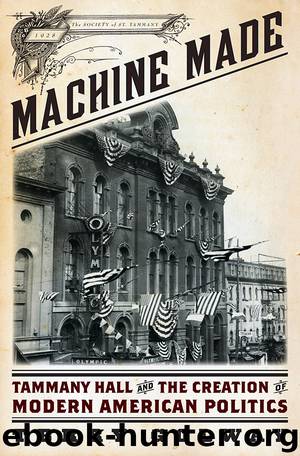
Machine Made by Terry Golway
Author:Terry Golway
Language: eng
Format: epub
Publisher: Liveright
Published: 2014-01-24T05:00:00+00:00
Seth Low may have had the best of intentions upon entering City Hall on a wave of anti-Tammany disgust, but as he prepared for reelection in 1903, history did not augur well for a repeat of the reform movement’s stunning victory in 1901. New York politics was littered with examples of reform administrations that did not earn a second term—a tribute to Tammany’s resilience but also testimony to the inability of reformers to understand the concerns of voters. Tammany’s George Washington Plunkitt famously described reform movements as “mornin’ glories”—they “looked lovely in the mornin’ and withered up in a short time, while the regular machines went on flourishin’ forever, like fine sturdy oaks.”18
If reformers seemed will-o’-the-wisp, perhaps that was because of their tenuous connection to the people whose interests they claimed to represent. Of the 2,312 members of the New York Reform Club in 1902, the vast majority, some 1,842, lived more than thirty miles from downtown Manhattan.19
The distance between reformers and the bulk of the city’s population was measured in more than just miles. Simply put, many reformers did not understand the everyday concerns of voters, or, if they did, they dismissed them as parochial and unworthy of a disinterested, reform-minded government. Richard Welling, who cofounded the New York Reform Club with Theodore Roosevelt in the 1880s, looked back on the reform movement’s attempts to win the support of labor leaders in the late nineteenth century with some frustration. In a speech in 1942, he noted that the club had sought to educate the labor leaders in “Tammany misrule” in the 1880s, but the effort to create a cross-class reform movement ultimately failed. “It was a tremendous blow to find all these men preoccupied with wage questions,” he noted with evident frustration. “As Bryce has said, the conspicuous example of failure of democracy is the misgovernment of American cities.”20
Welling’s dismissal of “wage questions”—that is, the demands of workers for better pay—was as telling as his reference to James Bryce, the British aristocrat and celebrated observer of American politics. Welling could not understand why working men were more concerned with their wages than with grand proposals for more efficient municipal government—this was not his idea of how disinterested citizens ought to behave. And so he turned to the wisdom of Bryce to explain it all: American cities were poorly run because men who worried about their wages voted accordingly, paying no regard to the purer virtues of republican democracy.
Groups like the New York Reform Club were contemptuous of the sort of politics practiced at the street and tenement level, so they had little understanding of why “wage questions” might seem more important than, say, ballot reform or temperance legislation. But Tammany leaders such as Barbara Porges lived with the people for whom she advocated, and she could report back to Charlie Murphy with firsthand observations of the concerns in her district.
Barbara Porges was the boss of the 2nd Assembly district on the Lower East Side, a Tammany operative who was working the tenements of Orchard Street long before women were granted the right to vote.
Download
This site does not store any files on its server. We only index and link to content provided by other sites. Please contact the content providers to delete copyright contents if any and email us, we'll remove relevant links or contents immediately.
| Africa | Americas |
| Arctic & Antarctica | Asia |
| Australia & Oceania | Europe |
| Middle East | Russia |
| United States | World |
| Ancient Civilizations | Military |
| Historical Study & Educational Resources |
Cat's cradle by Kurt Vonnegut(15383)
Pimp by Iceberg Slim(14544)
4 3 2 1: A Novel by Paul Auster(12422)
Underground: A Human History of the Worlds Beneath Our Feet by Will Hunt(12107)
The Radium Girls by Kate Moore(12045)
Wiseguy by Nicholas Pileggi(5801)
The Fire Next Time by James Baldwin(5459)
Perfect Rhythm by Jae(5421)
American History Stories, Volume III (Yesterday's Classics) by Pratt Mara L(5316)
Paper Towns by Green John(5202)
Pale Blue Dot by Carl Sagan(5021)
A Higher Loyalty: Truth, Lies, and Leadership by James Comey(4975)
The Mayflower and the Pilgrims' New World by Nathaniel Philbrick(4511)
The Doomsday Machine by Daniel Ellsberg(4499)
Killers of the Flower Moon: The Osage Murders and the Birth of the FBI by David Grann(4454)
The Sympathizer by Viet Thanh Nguyen(4405)
Too Much and Not the Mood by Durga Chew-Bose(4361)
The Borden Murders by Sarah Miller(4337)
Sticky Fingers by Joe Hagan(4211)
